

A financing shortfall estimated at more than $250 billion across the GCC is creating fresh opportunities for private credit providers, with the UAE emerging as a key market for alternative financing as businesses look beyond traditional bank lending.
Private credit, which provides financing through non-bank institutions, is gaining traction across sectors ranging from real estate and technology to healthcare, education, logistics and small-business lending, according to analysis from Nisus Finance. The company estimates that the GCC and Egypt private credit market could grow by 15-30 per cent annually, reaching between $11 billion and $20 billion by the end of the decade.
The growth comes as companies increasingly seek capital structures that are more flexible than those typically offered by banks. While property remains a major area of activity, demand is spreading across a wider range of industries requiring expansion, acquisition and growth capital.
The trend is particularly evident in the UAE’s real estate sector, where developers are looking for alternatives to conventional lending for acquisitions, bridge financing, project completion and recapitalisation. Dubai’s property market recorded more than Dh680 billion in investment across over 258,000 transactions in 2025, highlighting the scale of funding requirements within the sector.
Amit Jhunjhunwala, Chief Investment Officer, UAE, at Nisus Finance, said private credit should be viewed as a complement to banks rather than a competing source of finance. “Private credit is not replacing banks. It is completing a capital structure that has traditionally had a gap between what a deposit-taking institution can prudently lend against and what a business or asset actually requires to grow, develop or complete a transaction,” he said.
According to Jhunjhunwala, the financing need is structural rather than cyclical because prudential regulations naturally limit the types of lending banks can undertake. This creates a long-term role for private credit, particularly for SMEs and businesses whose funding requirements may not fit conventional lending criteria.
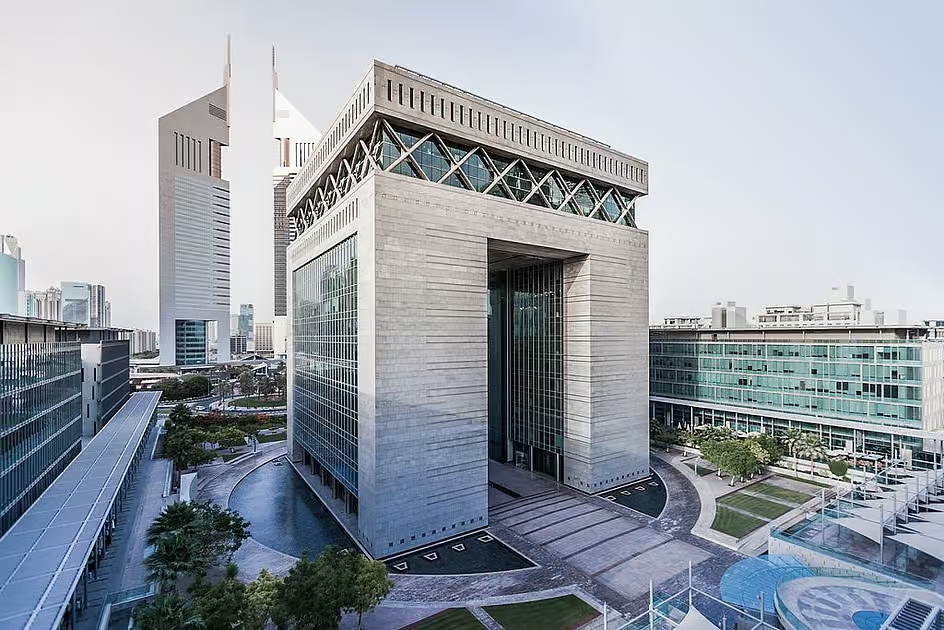
The UAE is seen as well-positioned to benefit from the sector’s expansion due to the presence of financial centres such as Dubai International Financial Centre (DIFC) and Abu Dhabi Global Market (ADGM), whose regulatory frameworks and fund structures have helped attract institutional capital.
Although private credit remains relatively underdeveloped in the region, growth prospects are significant. In 2021, private credit accounted for only around 3 per cent of total real estate debt across the UAE and Saudi Arabia, suggesting substantial room for expansion.
Over the next three to five years, activity is expected to broaden beyond property into technology, growth-stage companies, education, healthcare, logistics and supply-chain businesses. Capital-intensive sectors such as data centres, digital infrastructure, warehousing, healthcare facilities and hospitality are also expected to generate demand for structured financing solutions.
Jhunjhunwala said the growing investment relationship between India and the Gulf could further support the market’s development.
“India and the GCC are developing an increasingly important capital corridor. Gulf capital has duration, while Indian businesses and assets require duration capital. Private credit has the potential to become an efficient instrument connecting these two markets,” he said.
Looking ahead, he said the sector’s long-term success would depend on disciplined lending practices and strong risk management.
“The GCC has the demand, regulatory architecture and capital required for private credit to develop into a meaningful institutional asset class,” Jhunjhunwala said.”The opportunity extends well beyond any single sector as businesses across the region look for more flexible sources of capital.”
Source: Khaleej Times